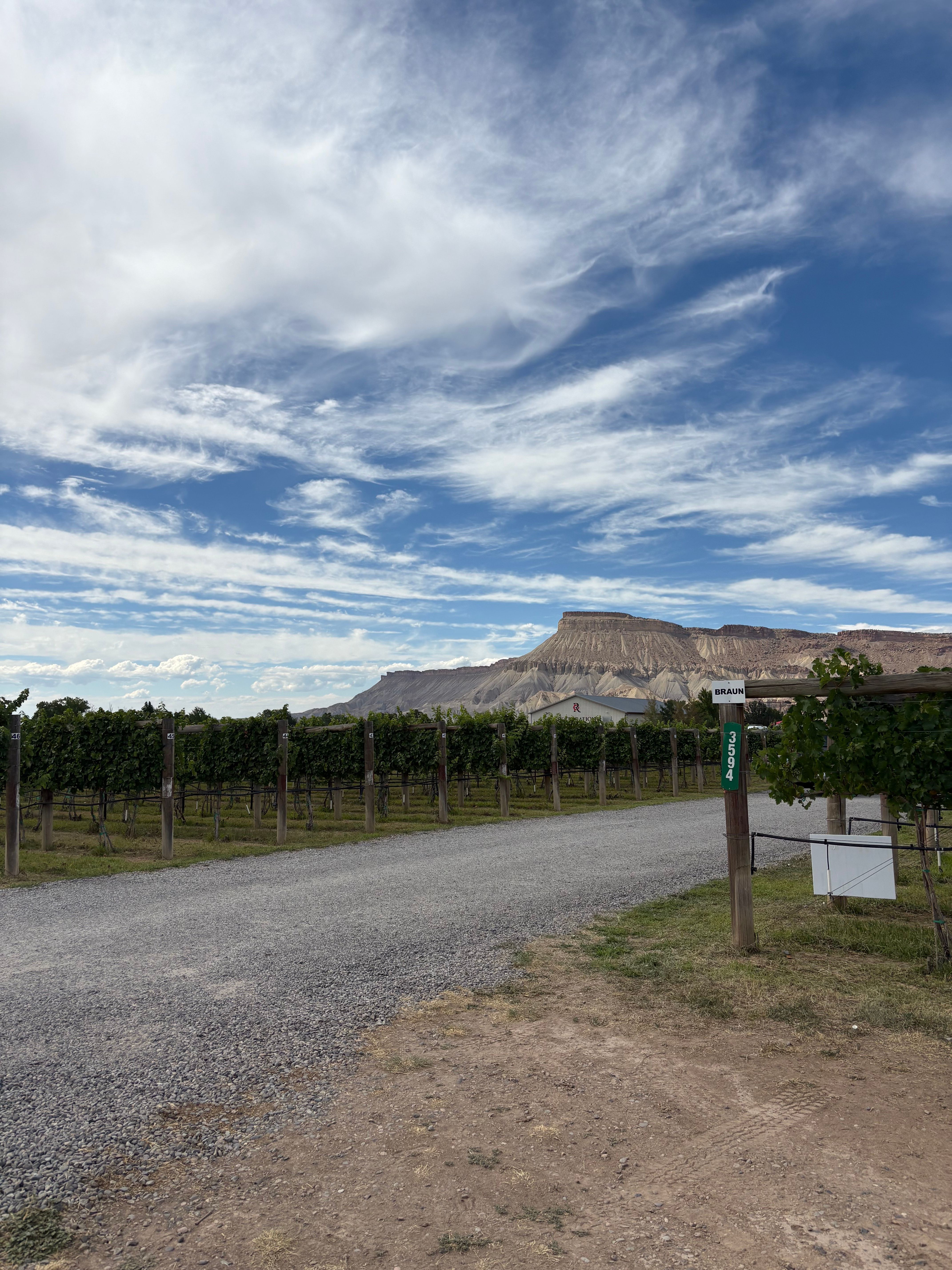
Palisade
History & Culture
Founding & History
Palisade sits where the Grand River, renamed the Colorado River in 1921, carved an arid valley beneath steep Mancos Shale cliffs. Long before orchards filled the landscape, Ute people lived throughout the Grand Valley. White settlement began in the early 1880s when J. P. Harlow raised fruit and vegetables on his Rapid Creek ranch in 1882, followed by W. A. Pease, who homesteaded 160 acres in 1884 that became the town’s south and west sides.
Water quickly proved vital. Harlow sent Rapid Creek water through the Grapevine and Crawford ditches, while other ranchers hauled barrels from the Grand River until they could build reliable canals. Early growers also discovered the protective power of the surrounding palisades and the “million-dollar” katabatic winds that sweep out of DeBeque Canyon each dawn, guarding blossoms from spring frost. Those conditions still explain why most of Mesa County’s 2,200 peach acres lie east of Mount Garfield.
Irrigation turned the desert green. The first diversion dam on the Grand Valley Canal rose south of town in 1883, and later projects created one of the most productive farm regions in the Intermountain West. Coal added another boost. George Smith opened Bookcliff Coal Mine west of Mount Garfield in 1884, and by 1899 he had discovered a rich vein three miles east of town that became the Cameo Mine, later feeding the Public Service Company power plant built in 1957. Though the plant closed in 2010, the site now hosts the Cameo Shooting and Education Complex.
Water engineering reached a peak in 1915 with completion of the Grand River Diversion Dam, a 14-foot-high, 546-foot roller crest structure begun in 1897. Five of its six seventy-foot steel cylinders raise and lower to keep rail lines above flood level while sending water into the 55-mile Government Highline Canal, which irrigates about 33,000 acres from Palisade to Mack.
Today the valley holds more than 500,000 peach trees, 1,000 vineyard acres that supply 90 percent of Colorado’s wine grapes, and expanding hop and lavender fields. The Grand Valley American Viticultural Area, established in 1991, recognizes the region’s quality. You can explore that story on a guided walking tour with the Palisade Historical Society or pick up a self-guided brochure downtown.
Cultural Significance
- Agriculture and viticulture define Palisade’s identity, with orchards, vineyards, peaches, and wine tourism deeply integrated into local economy and culture.
- The historic Cameo Shooting & Education Complex now occupies the former power plant site built in 1957, linking Palisade’s coal-mining past with modern recreational infrastructure.
- Events often pair live music, local art, and culinary experiences, fostering a creative small-town atmosphere.
Notable Events & Stories
- Palisade Peach Festival
A long-standing tradition since 1930 (with origins in the 1887 “Peach Day”), this beloved festival celebrates Palisade’s famous peaches through parades, fruit contests, chef demos, live music, and even a Peach Queen crowning. It was revived in 1975 and continues to be a highlight of the summer. - Colorado Mountain Winefest
Held every September, this wine festival showcases dozens of local wines, meads, and ciders. Voted “Best Wine Festival in the Nation” by USA Today’s 10Best in 2017, it's a key cultural and tourism driver in the region. - Grand Valley Diversion Dam
Built between 1913 and 1916, this roller-gate dam—one of the first of its kind—was crucial for irrigating vast tracts of farmland. It still powers agriculture today and became a historic landmark in 1991.
Local Heroes & Notables
-
Wayne N. Aspinall
A long-serving U.S. Congressman (1949–1973), Aspinall chaired the influential House Interior and Insular Affairs Committee and played a central role in shaping Western land and water policy. He spent much of his life in Palisade, making the town his home. -
Clair Finch
Born in Palisade, Finch went on to become a lawyer and served as a state legislator in Wisconsin—making him one of Palisade’s most prominent native-born public figures. -
JoAnn Rasmussen
As Chair of the Palisade Historical Society and co-owner of the Crissey House—the only residence in town on the National Register of Historic Places—Rasmussen is actively preserving Palisade’s architectural and social history through walking tours, archival projects, and storytelling. -
J.P. Harlow
A pioneer grower whose irrigation innovations enabled thriving orchards, J.P. Harlow homesteaded the land around 1884–1886, laying the groundwork for what would become the south and west parts of modern-day Palisade.
-
W.A. Pease - In 1884, W.A. Pease homesteaded 160 acres that now form the southern and western sections of Palisade, becoming the first settler directly on the future townsite
Fun & Surprising Facts
- Palisade is renowned for its peaches and is known as the "Peach Capital of Colorado".
- The valley town has more than 500,000 peach trees. Palisade peaches typically ripen on the tree until they reach peak flavor, sweetness, and size; many swell to softball size.
- The region is nestled within Colorado’s first federally recognized American Viticultural Area (Grand Valley AVA). Vintage Colorado Cellars prompted this designation in 1991. Today, Palisade and its surroundings account for most of the state’s grape production.
- Yes—Palisade is home to more than just orchards. You can meet alpacas at places like Suncrest Orchard, while herds of wild horses roam freely in the nearby Little Bookcliffs area.
- Locals often refer to Mount Garfield (and the Book Cliffs beyond) as the “Sleeping Indian”—a natural skyline silhouette resembling an Indian's head at rest.