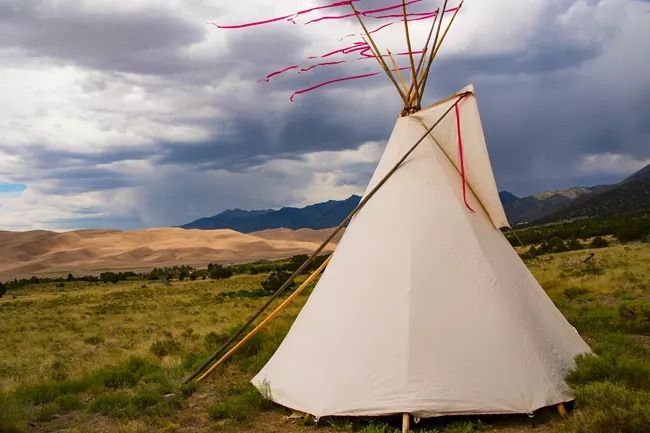
Great Sand Dunes National Park and Preserve
History & Culture
Park History
People have lived with the Great Sand Dunes for thousands of years. Around the dunefield, archeologists have found manos and metates, stone tools used to grind seeds and other plant materials. All natural and cultural objects at Great Sand Dunes are protected by federal law; if you encounter an artifact, please leave it in place and notify a ranger.
Paleo era
New research suggests the first peoples reached North America earlier and by more complex routes than once thought. While a Bering Land Bridge crossing may have been primary, coastal travel by boat was also likely. Fossilized human footprints at White Sands National Park dated at 22,000 years BP (Before Present) push human presence back well before earlier estimates of 13,000 years BP. One way archeologists trace early peoples is through distinctive projectile points: the 1920s discovery near Clovis, New Mexico of mammoth remains with long spear points documented mammoth hunting and gave rise to the term “Clovis culture.”
In the same decade, bones from large prehistoric bison (Bison antiquus) with much smaller, thinner points were found near Folsom, New Mexico, prompting the “Folsom culture.” With evidence that people were present before Clovis, researchers now also identify varied Pre-Clovis points.
At Great Sand Dunes, Pre-Clovis artifacts have likely been found but not yet confirmed; shifting sands can disturb stratification and complicate identification. Clear evidence does show Clovis and Folsom era people here toward the end of the last ice age, when melting glaciers created extensive wetlands and grasses that supported Columbian mammoth and Bison antiquus. As mammoths disappeared due to natural climate change and hunting pressure, Folsom hunters focused on Bison antiquus and smaller mammals.
Hunters used the atlatl, a lever that extends the thrower’s arm and can propel darts at over 100 mph (160 kph); lighter Folsom points helped darts travel farther. Hunting massive Pleistocene mammals was dangerous, mammoth or Bison antiquus could injure or kill people, and predators such as sabertooth cats and short-faced bears were drawn to meat. Paleo peoples needed deep knowledge of plants for food, medicine, and fiber; skill in crafting tools and clothing; an understanding of weather, animal movements, and regional geography; and ways to pass knowledge, stories, and beliefs to each generation.
A major Folsom-era site within today’s national park, excavated by the Smithsonian over 15 years, shows at least 49 bison driven against a small dune and killed with atlatls. Four to seven families worked together over about a week to dry meat, prepare foods, make new points, and produce clothing and tent covers. Stone sources at each household suggest a gathering of people from different regions. Margaret (Pegi) Jodry supervised the excavation and documented it in her thesis, Folsom Technological and Socioeconomic Strategies: Views from Stewart’s Cattle Guard and the Upper Rio Grande Basin, Colorado. Smaller nomadic family bands sometimes met to hunt, trade, share resources, find spouses, and hold ceremonies. Long a landmark and resource-rich place, Great Sand Dunes served as a regional meeting ground.
Archaic era
Beginning about 8,000-6,000 years BP, the climate warmed and dried and most Ice Age megafauna were gone. Points from this era are generally narrower, likely used for elk, deer, and modern bison. Bow-and-arrow technology appeared late in the Archaic, around 1,600 years BP, prompting even smaller points. Pithouses, a circular pit roofed with timbers and hides or brush, were common; archeologists found a small seasonal pithouse west of the dunefield. Pottery, fishing, and agriculture became more prevalent, though the San Luis Valley’s short growing season does not suit typical Archaic crops of corn, beans, and squash. Due to harsh winters, Indigenous peoples historically spent spring through fall in the valley, retreating to lower elevations in winter.
About 6,000 years ago an extremely dry period known as the Altithermal began; for roughly 2,000 years, edible plants and animals were scarcer here, human activity decreased, and the dunes likely grew as valley vegetation withered and sand became mobile. A turtle petroglyph in the park may date from this era.
Because projectile points have dominated studies, male hunting activities have often been emphasized. In the Archaic, abundant ground-stone tools illuminate gathering and plant processing by women and children, including horticulture (and later agriculture) and deadfall trapping of small mammals. Toys, artwork, jewelry, and musical instruments hint at social and spiritual life. For years, long tubular rocks found around the dunes puzzled archeologists; they are now recognized as lithophones, stone instruments that may once have filled evening air with worship or celebratory music.
Cultural Significance
Regional tribal names for the dunes reflect living connections to this landscape: Ute, So-wop-a-wot (“where the sand is”); Jicarilla Apache, Seinanyédi (“it goes up and down”); and Navajo (Diné), Tsé-whíz-hosh (“sand comes back down on you”).
Great Sand Dunes’ affiliated tribes share traditional knowledge through consultation and public programs; for them, this place is home. Through consultation, the National Park Service gains multigenerational cultural knowledge, supports continuation of traditional uses tied to ancestral lands, protects resources via future management partnerships, and communicates Native perspectives to the public.
Official seals of affiliated tribes, photo galleries, and videos (including cultural presentations by Jicarilla Apache and Navajo/Diné members) are available through park materials.
Notable Events & Stories
Hidden among the woodlands of Great Sand Dunes National Park and Preserve are culturally modified trees, living artifacts marked by peeled areas on ponderosa pines. Look closely and you’ll see the work of generations of Indigenous peoples who removed bark to use for building materials, cradleboards, and trays, and used sap or pitch medicinally, to waterproof baskets, and as an adhesive. The focus was the inner bark as food and medicine. At least 200 such trees are known across the park and preserve.
In 2000, a grove of 72 just east of the dunefield, Indian Grove, was listed on the National Register of Historic Places, and some of its ponderosa pines are 500+ years old.
Archeologist Marilyn Martorano used tree ring dating to show peel dates from 1777 to the early 1900s, with most from 1820 to 1879. Peeling was done by Indigenous groups, including the Capote band of Utes, and may also have involved Jicarilla Apache, Navajo Nation, and Puebloan peoples. Activity declined after 1879 with gold and silver discoveries and relocations in the 1880s.
Trees are usually peeled on one side, and rosin seals the scar so they live many years. Today, you can see a peeled tree on exhibit in the visitor center.