Grand Junction
Overview
Grand Junction is western Colorado’s largest city sitting about 247 miles west-southwest of Denver. It stands at approximately 4,586 feet (1,398m) in the 30-mile Grand Valley and takes its name from the junction of the Colorado and Gunnison rivers. The land first belonged to the Ute tribe, who were later relocated to Utah, and it then passed under the Kingdom of Spain before Mexican and Spanish soldiers searched the valleys for gold that never appeared.
A townsite was claimed in 1881 and named Ute, soon became West Denver, and finally settled on Grand Junction because the community lies at the junction of the Colorado (once the Grand) and Gunnison rivers. On July 22, 1882 George A. Crawford platted the streets and planted Colorado’s first vineyard near Palisade, launching an oasis that still ships peaches, pears, cherries, and apples while supporting a thriving wine scene. Narrow-gauge rails reached town in 1882, standard-gauge lines followed in 1890, and today Interstate 70 and U.S. 50 cross here, Amtrak stops downtown, and Colorado Mesa University enrolls nearly 10,000 students.
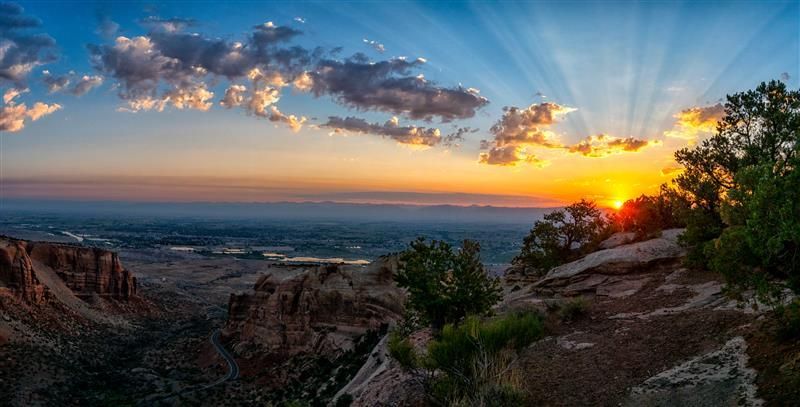
The surrounding landscape delivers Nature’s Trifecta. Colorado National Monument rises just west of town with red-rock canyons, Rim Rock Drive, pull-offs, easy and difficult hikes, and clear night skies for stargazing. Grand Mesa, the world’s largest flat-top mountain, levels off near 10,000 feet and has more than 300 alpine lakes for skiing, snowmobiling, fishing, hiking, and mountain biking. Rattlesnake Arches has over 35 natural spans, and you can visit without reservations or lines. Nearby McInnis Canyons National Conservation Area protects 25 miles of the Colorado River and marks the eastern end of the 142-mile Kokopelli Trail to Moab.
A temperate climate keeps trails open year-round, so you might hike or bike in sneakers and a light jacket while high-country snow waits just 45 minutes away for skiing, snowboarding, cross-country tours, and ice fishing. Rafters, paddlers, and anglers spread out on the Colorado and Gunnison rivers and at the James M. Robb Colorado River State Park, while more than 300 freshwater lakes dot Grand Mesa. Lunch Loop Bike Park sits at the edge of town, campers set up at Colorado National Monument and along the river, and the Liberty Cap Trail rewards a 3-mile climb with sunrise or sunset views. The Little Book Cliffs Wild Horse Range protects more than 100 mustangs on 36,000 rugged acres, adding true Western character to the high desert.