Alamosa
History & Culture
Founding & History
Long before any written record, Clovis and Folsom people hunted and gathered across what’s now Alamosa, leaving traces that reach back roughly eleven thousand years.
Spain laid claim to the land in the 1500s, tried to spark settlement with land grants, then saw the valley remain mostly open after clashes with Comanches. In 1807 explorer Zebulon Pike looked out from Medano Pass, took in the vast dunes, and carried that image home, and Spain’s rule lasted until Mexico won independence in 1821. Permanent settlements followed in the 1850s, marking the start of recorded community life in the San Luis Valley.
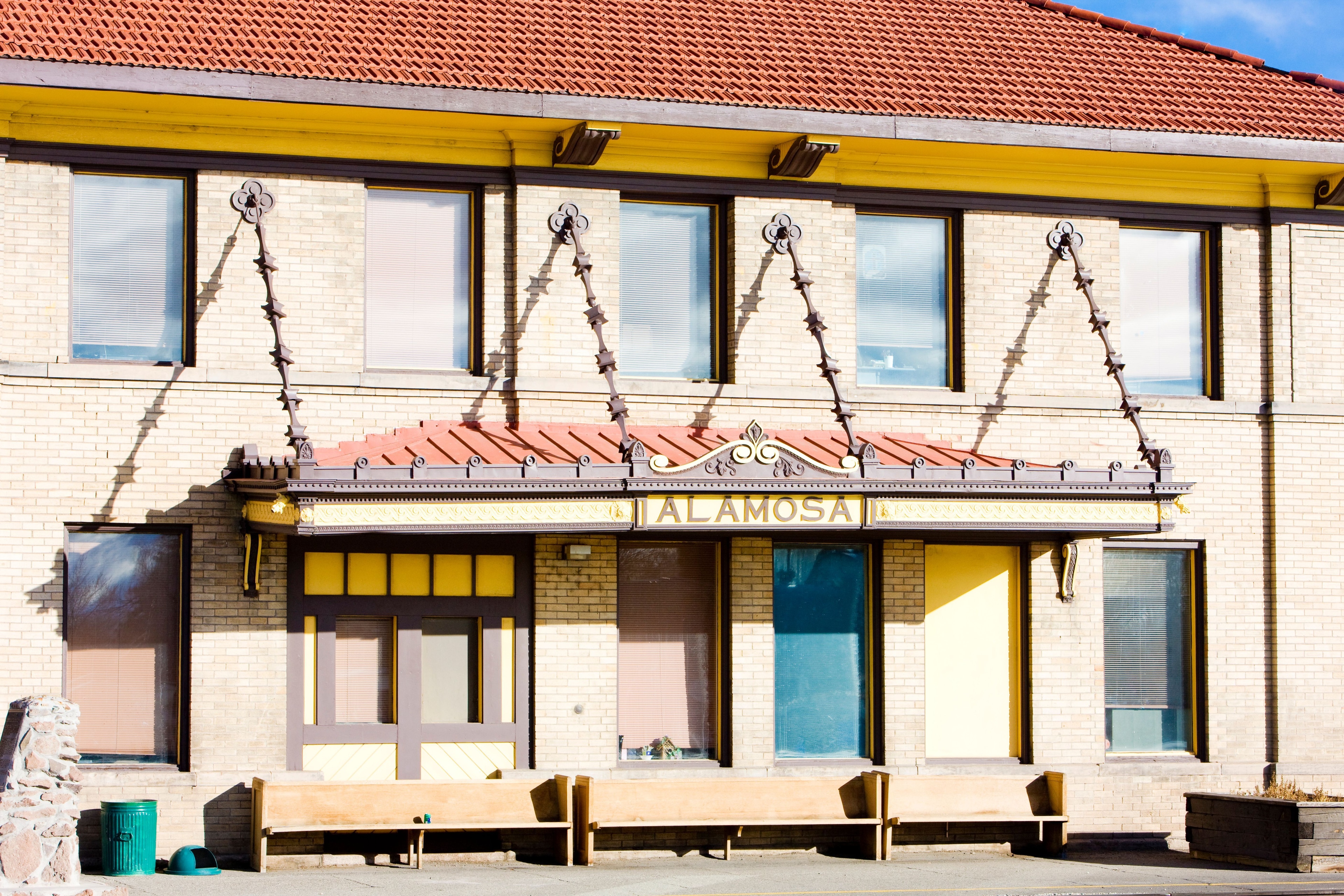
Gold and silver strikes near Summitville in 1870 drew miners and fortune-seekers, and new camps soon appeared at Creede and Bonzana. Yet the San Luis Valley’s lasting growth came from rail, farms, ranches, and timber. In 1878 a narrow-gauge train stopped at a bend in the Rio Grande shaded by cottonwoods, settlers unloaded nearly a hundred buildings in a single day, and the town of Alamosa, Spanish for “cottonwood grove”, was born.
Over the next decade rails stretched in all four directions, turning the young community into the valley’s transport hub.
Trains carried lumber and hardware in, hauled farm goods out, and helped Alamosa thrive. Adams State College opened in 1921 as a teacher-training school and now grants bachelor’s and master’s degrees, one of two higher-education institutions that serve a population of about sixteen thousand. Modern Alamosa pairs majestic mountain views, the winding Rio Grande, clear skies, breathing room, and productive farmland with a stable economy rooted in agriculture, education, and tourism.
You can step straight into that past by riding historic rail lines or weaving through nearby mining towns that still echo with stories. Stand on Medano Pass and gaze across dunes to distant peaks, and you’ll see the same sweeping panorama that left Zebulon Pike spellbound more than two centuries ago.
Cultural Significance
- Alamosa is known for the stunning landscapes of the Great Sand Dunes National Park, therapeutic hot springs, sparkling waterfalls, and wild lands teeming with thousands of birds.
- Alamosa is also home to Adams State University, founded 1921, which expands the city’s arts, athletics, and teacher-training footprint
Notable Events & Stories
-
Deep Roots & Civil Rights Legacy
One compelling story from Alamosa’s past is the Maestas v. George H. Shone case (1912–1914). Latino families challenged school segregation in a landmark lawsuit decades before more widely known cases—earning one of the earliest court victories against educational segregation involving Latino children.
-
SAR Success
In late May 2025, a two-injured camping duo stranded near the remote Deadman Lakes in the Sangre de Cristo range triggered a dramatic and successful rescue operation. The campers, suffering from injuries and acute mountain sickness, called for help using a Garmin inReach device. The Alamosa Volunteer Search & Rescue (AVSAR), in coordination with Saguache County Search & Rescue, responded promptly. As their ground team trekked toward the riders, aviation crews—including the Colorado Army National Guard (with a Black Hawk helicopter) and a Global Medical Response air unit—coordinated an urgent airlift. Within hours, the campers were safely transported to Alamosa’s San Luis Valley Regional Medical Center. The rescue concluded just after 10:40 a.m. This operation showcased the region’s rugged terrain, the critical role of AVSAR, and the efficiency of multi-agency collaboration in life‑or‑death situations.
-
Rio Frico Ice Fest & 5K
Every January, Alamosa transforms winter into a celebration with the Rio Frio Ice Fest. Imagine running a 5K race right on top of the frozen Rio Grande—plus, family-friendly fun like ice carving, cross-country skiing, “fire & ice” bonfires, and a quirky “faux snowman” contest where snowmen are built from anything but snow.
Local Heroes & Notables
-
Billy Adams
William Herbert Adams began his public service in Alamosa, serving as City Treasurer and Mayor. He later advanced through the Colorado legislature and became the 25th Governor of Colorado (1927–1933). Notably, he sponsored the creation of Alamosa State Normal School—now known as Adams State University—leaving a lasting educational legacy.
-
Ken & John Salazar
Ken Salazar, born in Alamosa, served as U.S. Senator from Colorado and currently stands as U.S. Ambassador to Mexico. His brother, John Salazar, also hails from Alamosa. He represented Colorado’s 3rd Congressional District (2005–2011) and later served as Agriculture Commissioner, leveraging his roots as a local farmer to advocate for water rights and rural communities.
-
Camille Herron
Born and raised in Alamosa, Camille Herron is a professional ultramarathon runner and world record holder. Her incredible endurance and local upbringing at high elevation have made her a source of inspiration and pride.
-
Alice Ivers "Poker Alice" Tubbs
Known as "Poker Alice”, Alice Ivers Tubbs was a famed frontier gambler in the Old West. After living in Alamosa, she gained legendary status for her sharp wit and card skills.
-
Joe "Coach" Vigil
Though born in Antonito, Joe Vigil was raised in Alamosa and later became one of the most celebrated long-distance running coaches in U.S. history. At Adams State University, he coached 425 All-Americans and over 20 Olympians, including Deena Kastor and Pat Porter. Recognized as a Legend Coach by USA Track & Field, a statue in his honor stands at Adams State.
-
Shirley Romero Otero
A Chicana activist with deep roots in the San Luis Valley, Shirley Romero Otero co-founded the Land Rights Council in 1977 to reclaim communal land access in the face of legal challenges. Her persistence paid off in a landmark class-action victory (Rael v. Taylor), affirming land usage rights for descendants of the Sangre de Cristo land grant. Her work continues through education, advocacy, and youth empowerment programs.
Fun & Surprising Facts
- World’s Largest High-Altitude Lake (Geologically): The San Luis Valley, where Alamosa sits, once held Lake Alamosa—one of North America’s largest high-elevation lakes, spanning over 4,000 km² during its peak in prehistoric times.
- A Railway Town Built in Pieces: In its early days, many of Alamosa’s first buildings were literally moved by rail. According to local legend, one of the town’s original buildings was loaded onto a flatcar—fed to railroad workers in Garland City one day, and then, by dinner that same night, reassembled in Alamosa.
- Spanish Roots—Cottonwoods & Names: “Alamosa” means “of cottonwood” in Spanish, referring to the cottonwood trees along the Rio Grande. The city was founded by the Denver & Rio Grande Railroad in 1878 and quickly became an important rail hub.
- Home of Ultramarathon Greats: Adams State University in Alamosa fosters elite athletic talent—especially runners, thanks to high-altitude training. One notable Alamosan, Camille Herron, is a world-record–holding ultramarathon runner.